HCPC Brands EuropeThe New Detergents Regulation (EU) 2026/405
Regulation (EU) 2026/405 of the European Parliament and of the Council of 11 February 2026 repeals and replaces Regulation (EC) No 648/2004, introducing a substantially expanded framework for detergents and surfactants placed on the EU market. It enters into force on 22 March 2026, but its core obligations only become mandatory from 23 September 2029 - giving manufacturers a multi-year window to prepare.
Timeline
| Date | Milestone |
|---|---|
| 22 March 2026 | Regulation enters into force (20 days after publication). |
| 23 September 2028 | Deadline by which the Commission is to adopt the methodology for micro-organism risk assessment (Art. 30(6)). |
| 1 October 2028 | Deadline by which the delegated act on digital labelling is to be adopted. |
| 23 September 2029 | Main provisions of the Regulation apply; Regulation (EC) 648/2004 is repealed. Article 4(3) and (4) follow later. |
| Before 23 September 2029 | Products placed on the market in conformity with Regulation (EC) 648/2004 may continue to be made available without a time limit. |
| 23 September 2029 - 23 September 2030 | Article 36 transition: products placed on the market on or after 23 September 2029 and before 23 September 2030 in conformity with Regulation (EC) 648/2004 may be made available until 23 September 2030. |
| 23 March 2032 | Films, and polymers contained in films, must meet the Annex I Part B biodegradability criteria. |
| 23 March 2034 | Intentionally added organic substances present at 10% w/w or more, calculated excluding water, other than surfactants, films and polymers within films, must meet the Annex I biodegradability criteria, subject to the derogations set out in Annex I, Part D. |
Scope & Key Definitions
Article 2 of Regulation (EU) 2026/405 defines a detergent broadly: any substance, mixture, or micro-organism (or combination) intended for cleaning, soaking, rinsing, or bleaching textiles, dishes, or surfaces - including the surface of fruit and vegetables - or to support a washing process alongside a laundry or dishwashing product. A surfactant is defined by its measurable surface-tension-reducing properties. Critically, an "end-user surfactant" - one made available to professional users or consumers rather than sold purely business-to-business for further formulation - triggers the same Digital Product Passport obligation as a finished detergent.
Product Requirements
- Biodegradability — surfactants must achieve full aerobic biodegradation, demonstrated using the methods specified in Annex I, Part A (the pass levels - for example ≥60% mineralisation or ≥70% removal in 28 days - depend on the method applied). Pre-adaptation of the inoculum is not allowed and the 10-day window principle does not apply.
- Micro-organisms — any intentionally added micro-organism must belong to, or be deposited in, a collection held by an International Depositary Authority, identified by whole genome sequencing, confirmed free of a defined list of pathogenic species, and supported by a formal risk assessment. Antimicrobial or disinfectant claims are banned unless the product separately complies with the Biocidal Products Regulation.
- Phosphorus limits — consumer laundry detergents are capped at under 0.5g total phosphorus per recommended dose; consumer dishwasher detergents at under 0.3g.
- Animal testing — compliance must be demonstrated using non-animal methods validated at EU or international level, and Article 7 prohibits placing on the market products whose final formulation or ingredients have been animal-tested for that purpose. Historical data from before 22 March 2026 remains usable, and a derogation is possible only by Commission implementing decision under the conditions set out in Article 7. Article 7 also leaves other relevant Union legislation unaffected, so testing obligations arising elsewhere - under REACH, for instance - continue to apply on their own terms.
Digital Product Passport & Ingredients Data Sheet
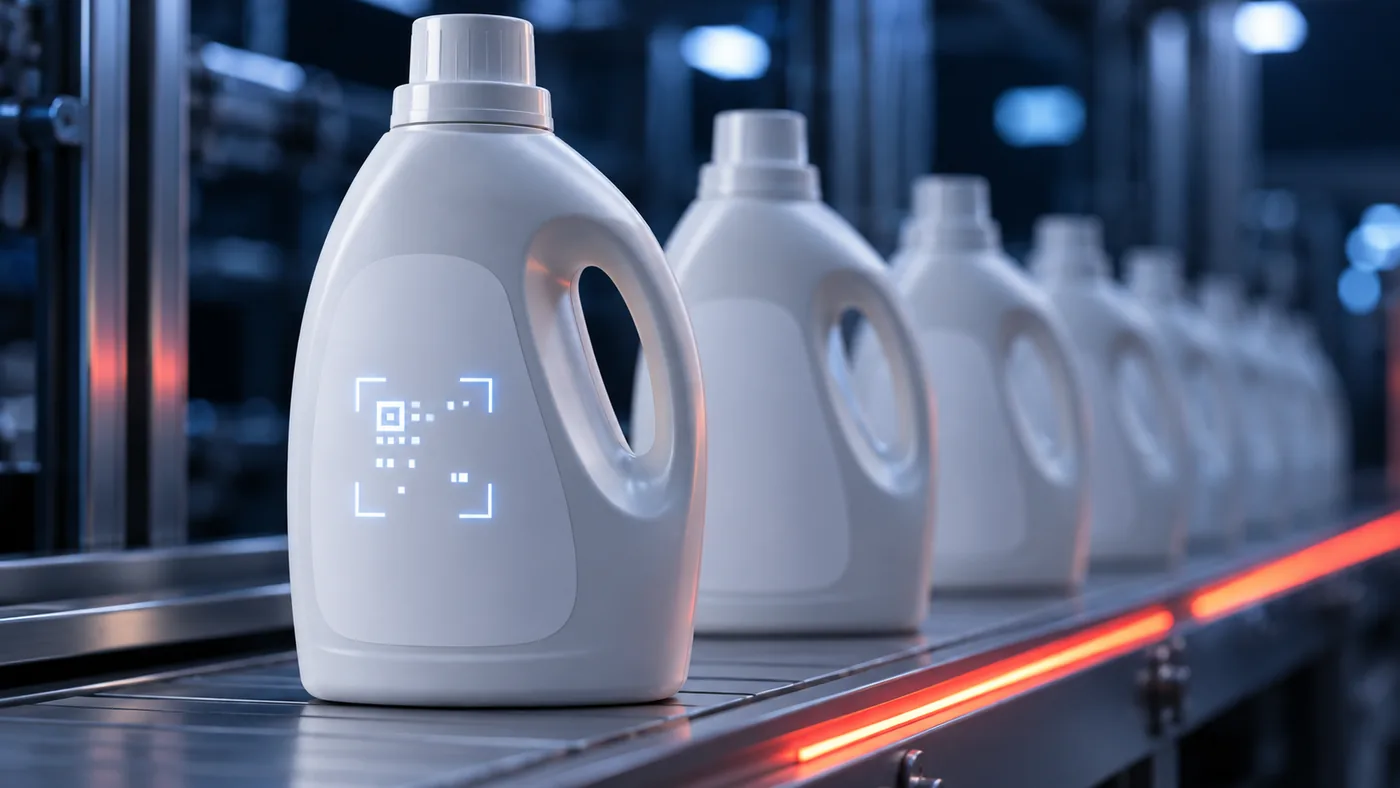
The Digital Product Passport requirement below arises under this Detergents Regulation itself. It uses infrastructure related to the EU's broader ESPR framework, but it is a separate legal basis: batteries, construction products and ESPR product groups each have their own passport route, scope and timing. Every detergent and end-user surfactant "model" requires a Digital Product Passport before it is placed on the market, created by the manufacturer before the product is placed on the market and kept accessible for ten years from the date on which the product concerned was placed on the market - including through insolvency or business closure, via a dedicated DPP service provider. A unique registration identifier, obtained by registering the DPP in the EU's product register, must be provided to customs on import. Separately, an electronic ingredients data sheet must be submitted to the body designated by each Member State. This applies to detergents and end-user surfactants that are mixtures for which no notification duty arises under Article 45 of CLP; it is not a duty for every mixture, and the C&L Inventory is not a substitute for it. The submission is made before the product is placed on the market. In the Netherlands the NVIC performs the equivalent role today; its designation under the new regime still has to be confirmed nationally.
Labelling Categories
Annex V, Part A organises mandatory label content into four groups: Group 1 covers 18 substance categories (surfactants, phosphates, bleaches, and others) disclosed in weight bands above 0.2% w/w; Group 2 covers enzymes, micro-organisms (new in this regulation), optical brighteners, and perfumes, disclosed regardless of concentration; Group 3 covers preservatives, now explicitly extended to "carry-over" preservatives introduced via raw materials rather than added directly; Group 4 covers fragrance allergens from an expanded list of 105 substances in Annex V, Part D, individually disclosed above 0.01% w/w. Apply the conditions and exceptions in Annex V, Part A, point 1(h) in full - including the concentration conditions for preservatives, the treatment of substances already labelled under CLP or the Biocidal Products Regulation, and the route by which eligible industrial and institutional products may provide the information through a safety data sheet instead.
A Note on Future HCPC Brands Services
This regulation introduces a role structurally similar to our existing Responsible Person service - but with a narrower, legally distinct scope. We are evaluating whether to offer a dedicated authorised-representative/DPP service for detergents. This page will be updated once that decision is finalised.
Source
Regulation (EU) 2026/405 of the European Parliament and of the Council of 11 February 2026, Official Journal of the European Union, L-series, 2026/405, published 2 March 2026.
Frequently Asked Questions
When does Regulation (EU) 2026/405 actually apply?
The regulation enters into force on 22 March 2026, but its main provisions apply only from 23 September 2029 under Article 37, when it repeals Regulation (EC) 648/2004. Until that date, the current Detergents Regulation (648/2004) remains in effect.
What happens to products already on the market when the new rules apply?
Products lawfully placed on the market under Regulation 648/2004 before 23 September 2029 may continue to be made available without limit. Products placed on the market under the old rules between 23 September 2029 and 23 September 2030 may still be sold until 23 September 2030.
What is the Digital Product Passport, and who needs one?
The DPP is a digital record required per product "model" for detergents and end-user surfactants, created by the manufacturer before placing the product on the market. It must remain accessible for ten years from the date on which the product concerned was placed on the market, backed up through a DPP service provider, and linked to a data carrier affixed to or included with the product or its packaging. This passport is required by the Detergents Regulation itself. It uses infrastructure related to the EU's ESPR framework, but batteries (Regulation (EU) 2023/1542), construction products (Regulation (EU) 2024/3110) and ESPR product groups each have their own legal basis, scope and timing.
Is the "authorised representative" role under this regulation the same as a cosmetics Responsible Person?
Structurally similar, but legally distinct and more limited. Article 9(5) keeps responsibility for drawing up the technical documentation with the manufacturer: it cannot be transferred to the authorised representative as a legal obligation. That is not a prohibition on practical support - a service provider may assist under the manufacturer's responsibility. The mandate itself is defined narrowly in Article 9(3)-(4), and Article 9(2) obliges manufacturers established outside the Union to appoint an authorised representative once the new regime applies from 23 September 2029.
Does this regulation replace REACH and CLP obligations for detergents?
No. Article 1(2) explicitly preserves REACH (Regulation 1907/2006), CLP (Regulation 1272/2008), and the Biocidal Products Regulation (528/2012) alongside this regulation. REACH, CLP and the Biocidal Products Regulation continue to apply where the product, its ingredients or its use fall within their respective scope. A biocidal claim, a treated article or a biocidal active substance brings the BPR into play; an ordinary cleaning product is not automatically a biocidal product.
Back to Knowledge Base, or see our GHS / CLP Labelling and Chemical Compliance Glossary pages.
Questions about how this affects your products?
Get in touch →